
Boiler PCB replacement
The printed circuit board sits behind most of the fault codes a boiler throws up. This page helps you work out whether yours has failed, find the right board for your model, and understand what part of the job you can do yourself.
Why several unrelated fault codes often mean one part
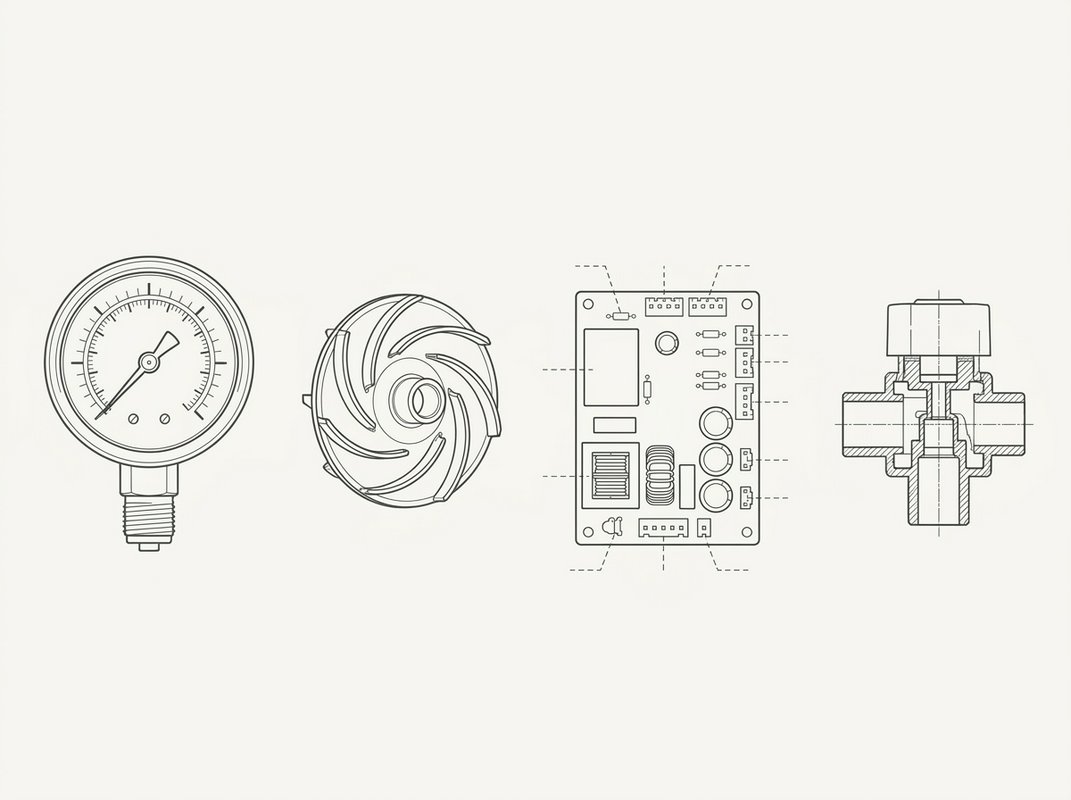
The printed circuit board (PCB) is the boiler's control centre. It reads the temperature and pressure sensors, times the ignition sequence, drives the fan and pump, and switches the diverter valve between heating and hot water. Every other part in the appliance either takes an instruction from the board or reports a reading back to it.
A failing board rarely announces itself with one clean symptom. It shows up as behaviour that does not quite add up: the boiler locks out partway through a cycle, the display goes blank and comes back, the fan runs but ignition never follows, or the system fires fine one day and not the next.
- Intermittent lockouts with no consistent trigger
- A display that resets, dims or goes blank without a power cut
- The fan or pump running when they should not be, or not running when they should
- Hot water or heating working while the other does not, with no obvious blockage
Why several fault codes at once point at the board
A single failed sensor or valve produces one fault code, tied to one circuit. When a boiler starts throwing codes for parts of the system that have nothing to do with each other, such as an ignition fault one day and a pressure reading fault the next, it is unlikely that several unrelated components failed in the same week. It is more likely that the board reading or interpreting those signals is no longer doing so reliably.
Codes still need reading individually before that conclusion is drawn. A page such as Baxi 200 and 400 Fault Codes sets out what each code means for that model range, which is the starting point for working out whether the pattern points to one component or to the board itself.
How PCB compatibility varies by boiler make and range
A PCB that fits one boiler in a range will not always fit another with the same badge on the case, because the board changes with the model year and sometimes the firmware. Use this as a starting point for what to check, not a substitute for reading the part number off the board itself.
| Boiler make | Where the PCB varies | Check before ordering | Firmware sensitivity |
|---|---|---|---|
| Worcester BoschBoard layout changed significantly with the Greenstar 8000 range | Differs between the Greenstar i, CDi and 8000 ranges | Match the board revision printed on the existing PCB. | Later boards can need reprogramming after fitting |
| VaillantCoding is usually part of installation. | Differs between ecoTEC plus and ecoTEC pro ranges | Confirm the appliance serial number range against the supplier's listing | Some replacement boards need coding to the specific appliance |
| IdealA visually identical board can carry a different connector | Differs across Logic, Logic+ and Vogue ranges | Check the part number against the label inside the casing. | Connector types have changed across production years |
| BaxiCodes on the 200 and 400 ranges are covered in more detail elsewhere on this site | Differs across the 200, 400 and Duo-tec ranges | Verify the fault code shown against the model and firmware it applies to | Fault code behaviour can differ between firmware versions on the same range |
| Glow-wormReconditioned stock is more common than new stock on discontinued ranges | Differs between Energy and Betacom ranges | Check whether the board is wired for the diverter valve type fitted | Older boards are increasingly hard to find new |
This reflects general patterns in how manufacturers revise boiler PCBs across a model range, not a checked list of current part numbers. Always confirm against the physical board and the manufacturer's own documentation before ordering.
Gas Safe and electrical rules for boiler PCB work
A boiler's printed circuit board is an electrical component, but it lives inside a gas appliance, and that combination is what decides who is allowed to open the casing and fit a new one.
What the regulations actually cover
The Gas Safety (Installation and Use) Regulations 1998 apply to work carried out on a gas appliance. A boiler's PCB sits between the gas valve, the ignition system and the safety sensors, and disturbing it means working inside the appliance itself. That places PCB replacement on a domestic boiler within the scope of the regulations, even though no gas joint is being broken.
This work must be carried out by a Gas Safe registered engineer. That applies to removing the casing, disconnecting the old board, fitting the replacement and putting the boiler back into service, because the board's wiring links directly to the gas valve and flame supervision circuit.
Why the electrical connections still matter
Fitting a PCB means working with mains voltage as well as low-voltage sensor and valve wiring. The boiler's electrical supply needs isolating before the casing comes off, and reconnecting it wrongly can leave a fault that shows up as ignition failure or lockout rather than as an obvious electrical fault. Where a boiler's fixed wiring is altered, rather than simply reconnected, that work falls under Part P of the Building Regulations, and the person carrying it out needs to be competent to do so or have the work checked by someone who is.
A board that throws several unrelated fault codes in sequence, of the kind set out for specific Baxi boilers on the Baxi 200 and 400 fault codes page, is often a sign that the board itself needs replacing. Confirming that still means opening up a live gas appliance, which is the point at which registration requirements apply regardless of how confident a homeowner feels about the diagnosis.
Where a homeowner's part ends
Ordering the correct board and checking it against the model and firmware details on the existing part is something a homeowner or landlord can do themselves. Removing the boiler casing, fitting the board and recommissioning the appliance is not, and that boundary does not shift depending on how straightforward the swap looks from the outside.
Reconditioned or new: what you're actually buying
What "reconditioned" means
A reconditioned printed circuit board (PCB) is a board that has already failed once, been opened up, and had the faulty component replaced. Common repairs are a failed relay, a blown fuse track, or a damaged connector, with the rest of the original board left as it was. Once the repair is done, the board is tested and sold on, usually at a lower price than a new OEM unit.
Why that matters for reliability
A board repaired to a good standard can run for years afterwards. But a board fixed only for the fault it was returned with may still carry other components that are close to the end of their working life, since the parts either side of the one that failed have usually done the same years of service. That's the trade-off reconditioned boards carry: a lower price against less certainty about what else on the board might be ageing.
Warranty implications
A new OEM board carries the manufacturer's own warranty terms. A reconditioned board carries whatever the supplier who repaired it chooses to offer, and that varies from one supplier to the next. Ask what the warranty actually covers before you order: some suppliers cover the whole board against any failure, others cover only the specific fault that was repaired.
Questions worth putting to a supplier before ordering
- What was actually replaced on this board, and what testing was done afterwards?
- Does the warranty cover the whole board, or only the repaired fault?
- What happens if the board fails again: replacement, refund, or a further repair?
- Has the part number and firmware version been confirmed against your specific boiler model?
A supplier listing that states when it was last checked, and what was checked, such as returns policy or stock availability, gives you something firmer to weigh than a product page on its own. If a fault code first pointed you towards a PCB problem, it's worth going back to confirm the exact code and part reference before choosing between new and reconditioned. The Baxi 200 and 400 fault code guide is one place to check that against, where the code applies to your model.
Find a supplier for your replacement PCB
Filter by new or reconditioned boards, dispatch speed and returns policy, with a last-verified date on every entry.