
Boiler expansion vessel: recharging and replacing
The expansion vessel keeps your heating system's pressure steady, and a worn one is a common reason a boiler keeps losing pressure. This page is for anyone working out whether theirs needs a top-up or a new one.
Find your fault code guideWhy your boiler pressure won't hold steady
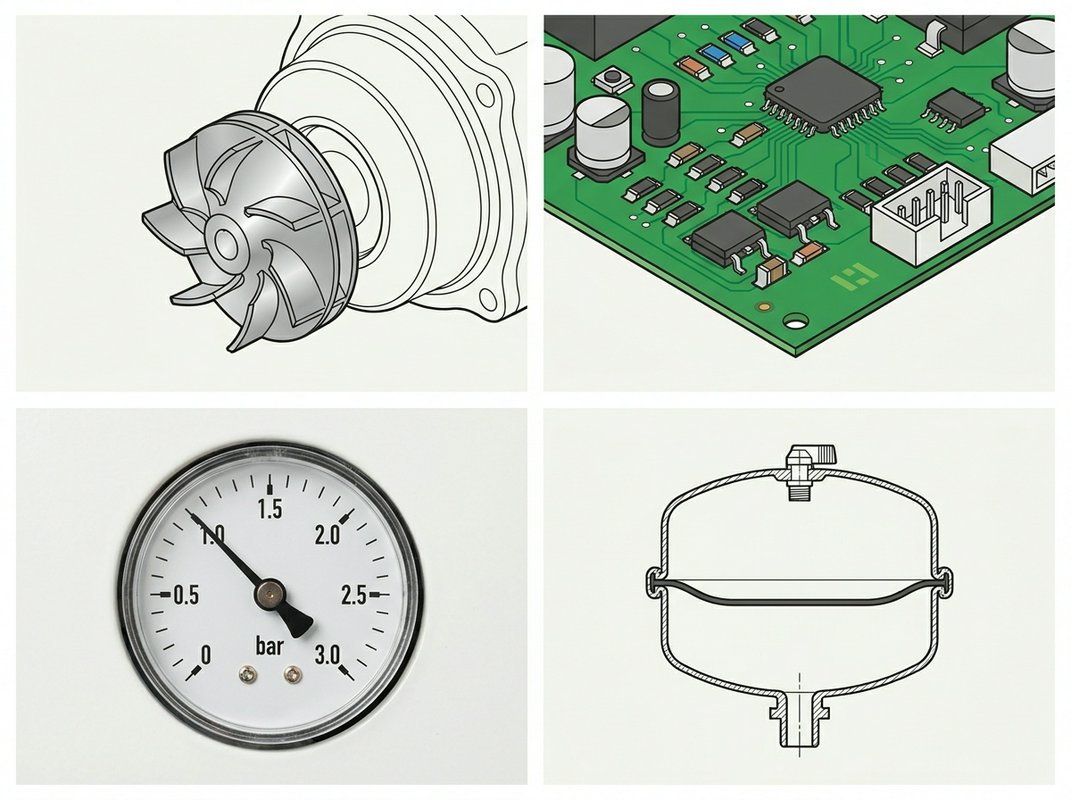
Water expands as it heats up. A sealed heating system has nowhere for that extra volume to go, so the expansion vessel sits on the pipework to take it: a steel shell split in two by a rubber diaphragm, with system water on one side and air (or nitrogen) charged to a set pressure on the other. As the water heats and expands, it pushes into the vessel and compresses the air cushion behind the diaphragm. As it cools, the cushion pushes back. That balance is what keeps your system pressure steady.
The diaphragm does that job thousands of times over the years, flexing with every heating cycle, and rubber under repeated flex eventually fails. It can split, perish, or simply lose its stretch. Once that happens the air charge either leaks away or mixes with the system water, and the vessel can no longer cushion the expansion.
What you'll notice
- The boiler pressure gauge creeps up every time the heating runs, then drops back once it cools.
- System pressure keeps falling and needs regular topping up, with no visible leak anywhere on the pipework.
- The pressure relief valve (PRV) discharges water outside the property, because the system has nowhere else to send the excess pressure a working vessel would have absorbed.
- Water finds its way out of the Schrader valve on the vessel itself, a sign the diaphragm has failed and system water has crossed into the air side.
A PRV that keeps discharging is the system telling you it's over pressure. The most common underlying cause is a diaphragm that's no longer doing its job. Recharging restores the air cushion where the diaphragm is still sound; where it's split or perished, the vessel needs replacing. The other sections on this page cover how to tell which one you're dealing with and what each repair involves.
Before you recharge the vessel, check this first
Recharging a vessel that's actually split won't hold, and it's worth ruling that out before you get the pump out.
-
System is fully depressurised
The heating pressure gauge should read zero before the Schrader valve cap comes off, or the reading you take afterwards means nothing.
-
Boiler is switched off and cooled
Recharging while the system is warm gives a false pressure reading as the water expands.
-
Correct charge pressure for the appliance
The figure to match is the one on the vessel's data plate or the manufacturer's service manual.
-
Schrader valve cap and core are undamaged
A worn valve core will leak air straight back out after recharging, so check it before assuming the vessel itself has failed.
-
Gauge used to check pressure is a tyre-type gauge
The boiler gauge reads system water pressure.
-
No water at the Schrader valve when depressed
Water rather than air coming through the valve points to a split diaphragm, which means the vessel needs replacing, not recharging.
-
System pressure re-checked and topped up after recharging
Correcting the air charge changes the water pressure reading, so this needs resetting to the boiler's normal operating range afterwards.
If the diaphragm has split, recharging won't fix it. That's a replacement job, and where the vessel is internal to the casing, access can bring you up against gas pipework that only a Gas Safe registered engineer is permitted to disturb.
Internal and external expansion vessels compared
Not every boiler hides its expansion vessel in the same place, and knowing which arrangement you have decides how much work is involved before you even reach the Schrader valve.
| Vessel arrangement | Where to find it | What to check before ordering |
|---|---|---|
| Internal vesselCommon on combi boilers, where space inside the case is designed around it | Built into the boiler casing, usually behind the front panel | Whether the casing needs removing to reach the Schrader valve, and how much clearance there is around it |
| External vesselCommon on larger combis and system boilers, where the internal space can't fit a big enough vessel | A separate cylinder mounted beside or below the boiler | The pipe connection and bracket type, since these differ between manufacturers |
| Manufacturer's rated pressureThe figure to work from when recharging or replacing, wherever the vessel sits | Printed on a label fixed to the vessel body | Check the vessel's own data plate for the correct pre-charge figure. |
This sets out the arrangements you'll typically meet. Charge pressure and part number vary by model and are printed on the vessel itself, so check that plate before ordering anything.
What you can and cannot do yourself
Topping up the pressure in an expansion vessel through its air valve does not involve the gas supply, so there is no restriction on doing it yourself. You are adding or releasing air on the sealed side of the vessel, well away from any gas-carrying pipework, and that is true whether the vessel sits externally on the pipework or inside the casing.
The line moves once you need to get an internal vessel out. On many boilers the vessel sits behind or beside the gas valve and its pipework, and reaching it means disturbing gas connections to clear a path. This work must be carried out by a Gas Safe registered engineer. It applies to disconnecting or moving gas pipework to access the vessel, so the same replacement can be entirely DIY on a boiler where the vessel is externally mounted and clear of the gas run.
Working out which case you have
Before deciding how to proceed, check what is actually in the way.
- Vessel mounted externally on its own bracket, with only water pipework and the air valve to deal with: recharging and replacement are both DIY-permissible.
- Vessel fitted internally, but accessible after removing panels without touching gas pipework: recharging is DIY-permissible; check the specific access route before starting any replacement.
- Vessel fitted internally behind or adjacent to the gas valve assembly, where gas pipework has to be loosened or moved to get it out: recharging is still fine, but the removal and refitting must go to a Gas Safe registered engineer.
If you are not sure which of these describes your boiler, the safer assumption is the last one until you have confirmed otherwise against your specific model. The Gas Safe rules for boiler repairs guide sets out more generally what is and is not restricted work, and is worth reading alongside this before you take a panel off.
Find a supplier for the vessel or the valve kit
A recharge only needs a Schrader valve kit; a failed diaphragm means a new vessel matched to your boiler's charge pressure.